Metal Roofing Longevity and Carbon Footprint
If you want lower long-term carbon output, roof life matters as much as roof material. From what I see in the research, metal roofing often lasts 40 to 70 years, can be fully recycled, and may cut cooling use by 10% to 25% in hot areas. That means fewer reroofs, less landfill waste, and lower lifetime emissions than shorter-life roofs.
Here’s the short version:
- I’d look at lifespan first: a longer-lasting roof spreads its upfront carbon over more years.
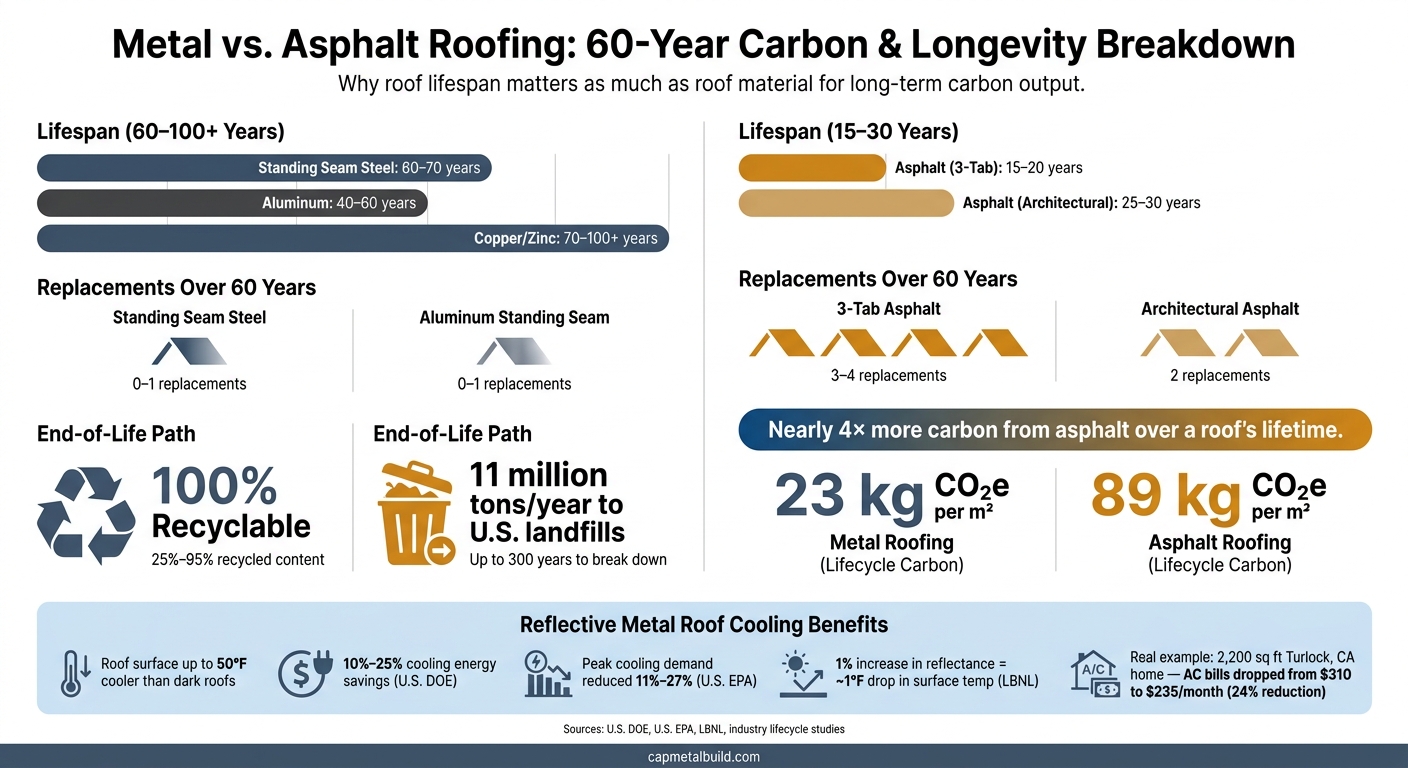
- I’d also look at replacement cycles: asphalt may need 2 to 4 replacements over 60 years, while standing seam metal may need 0 to 1.
- I’d factor in end-of-life waste: metal is recyclable, while asphalt shingles send about 11 million tons of waste to U.S. landfills each year.
- I’d check cool-roof performance too: reflective metal roofs can stay up to 50°F cooler than dark roofs and lower peak cooling demand.
- If I lived in Los Angeles or the San Gabriel Valley, I’d pay close attention to heat, UV exposure, coating quality, and installation.
Metal vs. Asphalt Roofing: Lifespan, Carbon & Cost Over 60 Years
Quick Comparison
| Roofing Type | Typical Life | Replacements Over 60 Years | End-of-Life Path | Cooling Impact |
|---|---|---|---|---|
| 3-tab asphalt | 15–20 years | 3–4 | Often landfill | Usually lower reflectance |
| Architectural asphalt | 25–30 years | 2 | Often landfill | Varies by product |
| Exposed-fastener metal | 20–30 years | 1–2 | Recyclable | Can be reflective |
| Standing seam steel | 60+ years | 0–1 | Recyclable | Strong cool-roof option |
| Aluminum standing seam | 40–60 years | 0–1 | Recyclable | Strong cool-roof option |
| Copper or zinc | 70–100+ years | 0 | Recyclable | Varies |
To me, the takeaway is simple: a roof that lasts longer, gets recycled, and reflects heat usually has a lower carbon load over time.
sbb-itb-e33e3b1
How long metal roofs last according to U.S. research
Service life ranges for steel, aluminum, and Galvalume roofs
U.S. research usually puts metal roof service life in the 40 to 70 year range under normal residential conditions. In plain terms, that means a metal roof often lasts decades longer than many other roofing options.
One multi-year U.S. study found that unpainted 55% aluminum-zinc–coated steel standing seam roofs showed no significant red rust after 35 years across five climate regions. That’s a strong sign of how well this material can hold up over time. With best-practice installation, service life can go beyond 60 years.
Aluminum standing seam systems usually land in the 40–60 year range. They’re a smart fit for coastal or high-humidity areas because aluminum naturally resists salt-air corrosion. If you live near the ocean, that detail matters a lot.
Coating quality has a big effect too. PVDF coatings like Kynar 500 or Hylar 5000 can keep finish durability for 30–50 years, while lower-grade SMP coatings may chalk and fade in 10–20 years. So it’s not just the metal itself that sets the clock. The finish plays a big part in how the roof looks and performs year after year.
The fastener system also matters. Standing seam panels use hidden clips that allow for thermal movement. That helps reduce the fastener fatigue that often limits exposed-fastener roofs to about 20–30 years.
Over a 60-year service window, those lifespan differences cut replacement cycles and waste. A roof that stays in place longer means fewer tear-offs and lower lifetime emissions.
How replacement frequency compares across roofing materials
Over 60 years, replacement frequency shapes material use, labor, transport emissions, and landfill waste. Every time a roof is replaced, you’re not just paying for new material. You’re also dealing with tear-off, hauling, and disposal.
A metal roof installed today may never need a full replacement during that period. Asphalt shingles, on the other hand, may need multiple full replacements over the same span. Each replacement adds new manufacturing emissions and disposal waste. Asphalt shingles alone make up about 11 million tons of U.S. landfill waste each year, much of it tied to shorter replacement cycles.
That lifespan gap turns into a carbon gap over the life of the building.
| Roofing Material | Typical U.S. Lifespan | Replacements Over 60 Years |
|---|---|---|
| 3-Tab Asphalt Shingles | 15–20 years | 3–4 |
| Architectural Asphalt Shingles | 25–30 years | 2 |
| Exposed-Fastener Metal | 20–30 years | 1–2 |
| Standing Seam Steel (Galvalume) | 60+ years | 0–1 |
| Aluminum Standing Seam | 40–60 years | 0–1 |
| Copper or Zinc | 70–100+ years | 0 |
Most non-metal roofs need at least one full replacement during a 60-year building life, which adds more waste and emissions.
How a longer lifespan lowers life cycle carbon emissions
Spreading embodied carbon across more years of use
Making metal takes a lot of energy. But looking only at the carbon released during manufacturing misses part of the picture.
A metal roof can last 40 to 70 years, so that upfront carbon gets spread over a much longer stretch of use. That brings down the annual carbon impact compared with roofing materials that often need replacement every 15 to 30 years. Put simply, metal roofing puts more of its carbon cost at the start. Asphalt roofing tends to repeat that cost each time the roof is replaced.
Recyclability and reduced landfill waste
End of life matters too. Metal roofing is 100% recyclable, and it often includes 25% to 95% recycled content. That has a big effect on energy use. Producing aluminum from recycled material uses only 5% of the energy needed to make it from raw ore. Steel has moved in the same direction: making steel today uses less than half the energy it did 40 years ago, which cuts greenhouse gas emissions by about 50%.
Asphalt shingles are a different story. They're petroleum-based, rarely recycled, and send about 11 million tons of waste to landfills each year. Once there, they can take up to 300 years to break down. And every reroofing cycle adds more waste.
You can see the same pattern in life cycle carbon data. Metal roofing comes in at about 23 kg CO2e per square meter, including end-of-life recycling, while asphalt tiles come in at about 89 kg CO2e per square meter. That's close to a 4-to-1 gap, driven mostly by two things: how long the roof stays in service and what happens to the material after it's removed.
Energy performance and cool-roof effects in hot climates
What studies say about cooling energy savings from reflective metal roofs
A long service life cuts embodied carbon. A reflective surface cuts operating carbon.
Reflective metal roofs lower operating emissions by reducing cooling demand. They do that through two main traits: solar reflectance, which sends sunlight back away from the roof, and thermal emittance, which lets absorbed heat escape. On a sunny afternoon, a reflective metal roof can stay up to 50°F cooler than a standard dark roof.
Research from the U.S. Department of Energy and related studies puts cooling energy savings at 10% to 25% for homes with cool metal roofs. The U.S. EPA says peak cooling demand can drop by 11% to 27% in air-conditioned homes. Lawrence Berkeley National Laboratory found that each 1% increase in roof reflectance cuts roof surface temperature by about 1°F.
That’s a simple tradeoff with a big payoff: less heat sitting on the roof means less work for the AC system.
PVDF coatings and cool pigments help metal roofs keep their reflectance and UV resistance for decades.
Why this matters in Los Angeles and the San Gabriel Valley
Los Angeles already deals with high heat, and the urban heat island effect makes it worse. Urban air temperatures can run 6°F to 12°F higher than nearby rural areas. In the San Gabriel Valley, that puts even more pressure on the roof during summer. When the roof pulls in less heat, the home needs less cooling, uses less electricity, and produces fewer indirect emissions.
California Title 24 sets minimum solar reflectance rules for many reroofs in inland climate zones 10–15.
One California example makes the point plain. A 2,200 sq. ft. home in Turlock switched from dark non-cool shingles to light-colored standing seam metal. Summer AC bills fell from $310 to $235 per month, a 24% reduction. Over the life of the roof, that points to lower electricity use year after year.
Standing seam metal roofs also work with non-penetrating solar mounts, which helps protect roof integrity and supports a long service life.
Still, these results depend on installation quality and how well the finish holds up over time.
What the research means for homeowners choosing a long-life roof
How installation quality, coatings, and maintenance affect carbon outcomes
A metal roof cuts carbon over time only if it lasts as long as it’s supposed to.
That’s the key point. The carbon case for metal roofing depends on real-life performance, not just lab numbers or product claims. If the roof fails early, the math changes fast.
Installation quality and upkeep play a big part in whether a metal roof reaches its expected service life. Common failure points include over-tightened fasteners, poor flashing around penetrations, and weak attic ventilation. In California, contractors should hold a C-39 Roofing Contractor license. Homeowners should inspect the roof once a year, clear off debris, and check flashing and penetrations to help stop early failure. This matters even more in places with constant heat and sun exposure.
Applying this research locally through CAP Metal Build

For homeowners in the San Gabriel Valley, this shows up most clearly during installation. For San Gabriel Valley homeowners, CAP Metal Build puts these ideas into practice through metal roofing, solar integration, gutters, and metal fencing.
Conclusion: Longer roof life generally means a lower long-term carbon impact
The research points the same way across the board. Because metal roofing lasts so long, its embodied carbon is spread over many more years than shorter-lived roofing materials. That means fewer tear-offs, fewer replacement cycles, less manufacturing energy, less raw material use, and much less landfill waste.
Metal is 100% recyclable at end of life, and reflective finishes can lower cooling demand year after year. Put those together and the picture gets pretty clear: long roof life, recyclability, and steady energy performance can cut lifetime carbon impact, especially in hot Southern California climates. In hot, sunny areas, a long-lasting, recyclable roof tends to offer the strongest long-term carbon edge.
FAQs
Is a metal roof’s higher upfront carbon worth it?
Yes. Making metal roofing takes a lot of energy up front. But a 40–70-year lifespan helps balance that out, because you may avoid one or two full re-roofing cycles and the landfill waste that comes with them.
There’s also the energy-use side of the equation. A metal roof’s reflective surface can cut home cooling use by 10–40%, which can lower the roof’s total carbon footprint over time.
CAP Metal Build installs long-lasting metal roofing in the San Gabriel Valley.
What affects how long a metal roof lasts?
A metal roof usually lasts 40 to 70 years, but the actual lifespan can vary quite a bit.
The first big factor is the material itself. Steel and aluminum roofs often last 40 to 60 years. Copper and zinc can last more than 100 years.
After that, performance comes down to a handful of things: installation quality, panel design, coating quality, local climate, and regular maintenance.
And that last part matters more than many homeowners think. Simple upkeep, like removing debris twice a year, can help a metal roof last longer and avoid wear that sneaks up over time.
Will a reflective metal roof lower my summer AC use?
Yes. A reflective metal roof can lower summer air conditioning use because it reflects a large share of the sun’s heat instead of soaking it in and holding it.
That cooler surface means less heat moves into your home, which can reduce indoor heat buildup and lower cooling costs by 10% to 40%.