5 Ways Metal Roofs Lower Cooling Costs
Yes - cool metal roofs can lower summer cooling bills, often by 10% to 25%. They do that by reflecting more sunlight, staying much cooler than dark roofs, and sending less heat into your attic and living space.
If I had to sum up the whole article in a few lines, it’s this:
- Cool coatings reflect 60% to 85% of solar heat
- Roof surfaces can stay more than 50°F cooler
- Attics can run 20°F to 30°F cooler
- AC systems run less during hot afternoon hours
- Savings tend to be strongest in hot, sunny places like Southern California
One study cited in the article found that a painted metal roof cut cooling costs by about 23% per year compared with a dark shingle roof. And in California, cool roofing can trim annual cooling costs by 20% to 30% in the right conditions.
Quick Comparison
| Factor | Dark Asphalt Roof | Cool Metal Roof |
|---|---|---|
| Sunlight reflected | 5%–20% | 60%–85% |
| Hot-day roof surface temp | 150°F+ | About 90°F–100°F |
| Cooling cost impact | Baseline | 10%–25% lower |
| Typical lifespan | 15–30 years | 40–70 years |
What matters most is simple: a cooler roof puts less heat into your home. That can mean lower bills, less attic heat, and less strain on your AC over time.
sbb-itb-e33e3b1
How Cool Metal Roofing Works
To see why metal roofs can trim cooling costs, it helps to understand three terms: solar reflectance, thermal emittance, and Solar Reflectance Index (SRI). Each one tells you something a little different about how a roof handles heat. Put them together, and the picture gets pretty clear: cool metal roofing stays cooler in hot weather and sends less heat into the home.
Solar Reflectance
Solar reflectance is the amount of sunlight a roof bounces away instead of soaking in. The higher the reflectance, the less heat the roof takes on. Cool metal roofs can reflect 60% to 85% of solar radiation.
Thermal Emittance
Thermal emittance measures how fast a roof gives off the heat it has absorbed. A roof that releases heat faster won't stay as hot for as long, which helps limit heat transfer into the building.
Solar Reflectance Index (SRI)
SRI blends reflectance and emittance into one rating that shows overall roof coolness. It makes side-by-side roof comparisons much easier. A white metal roof often has an SRI above 80, while a reflective brown metal roof may land between 40 and 50.
Modern "cool" pigments also help darker colors perform better than many people expect. Shades like forest green or bronze can reach higher solar reflectance than older materials in the same color. In hot climates, that matters all day long because the roof takes in less heat from the start.
Cool Metal vs. Dark Asphalt
The surface temperature gap can be huge. On a hot, sunny afternoon, a standard dark roof can hit 150°F or more, while a reflective metal roof in the same conditions can stay more than 50°F cooler.
That difference isn't just a number on paper. A cooler roof surface means less heat pushing indoors, which is where the first drop in cooling costs starts to show.
Here's how that turns into lower bills.
Why Cooling Savings Are Strongest in Hot U.S. Climates
Surface-temperature gains matter most in places where roofs sit in direct sun for months at a time. That’s why metal roof savings tend to be strongest in hot parts of the U.S. The roof simply spends more time pushing heat away from the house.
In hot regions, the warm stretch often runs from late spring into early fall, and sometimes even longer. In the San Gabriel Valley, that means the roof stays under stress through most of the warm season. Over time, that steady drop in heat gain can turn into real savings on cooling bills.
High Sun Exposure and Long Cooling Seasons
In cooler areas, a roof may deal with heavy heat for only part of the year. In hotter areas, that same heat lingers well past a short summer window. A reflective roof gets more chances to cut cooling demand, day after day, during a much longer season.
Time-of-Use Electricity Rates
Time-of-use pricing makes this even more important. Power costs more during peak afternoon hours, which is also when the house has already soaked up the most heat and the AC is working its hardest.
A reflective metal roof helps right when power is most expensive. It cuts how much heat builds up in the attic and living areas during those peak-rate hours. In plain terms, the AC doesn’t have to work as hard when each hour costs more.
San Gabriel Valley Example
The San Gabriel Valley gets frequent 100°F+ heat waves in late August. That gives reflective roofing more chances to reduce heat gain and lower cooling demand across the season. California's Title 24 cool-roof rules also make reflective metal systems a smart fit in many zones.
For homeowners in California, switching to a cool roofing system can cut annual cooling costs by 20% to 30%.
The biggest savings start with the roof’s reflective coating.
1. High Solar Reflectance From Cool Coatings
Cool-coated finishes do most of the work when it comes to lowering heat gain. They use reflective pigments to bounce a large share of the sun's energy away before that energy turns into heat. Standard dark roofing soaks up much more sunlight, while cool coatings can reflect up to 85%. That gap in reflectance can drop roof temperature fast, and you see it first right at the roof surface.
On sunny summer afternoons, reflective roofs can stay more than 50°F cooler than conventional roofs. In hot climates, that cooler surface helps cut the heat moving into the attic and the rooms below. Less heat on the roof also means less heat radiating downward into the living space.
Color still plays a part, but the coating itself matters even more. Newer cool pigments help darker metal roofs perform better than older finishes. That lower heat load is what kicks off the chain of cooling savings.
2. Lower Roof Surface Temperatures
Reflective coatings keep roof surfaces much cooler. According to the U.S. Department of Energy, conventional roofs can hit 150°F or more on hot, sunny afternoons, while reflective roofs can stay more than 50°F cooler.
That drop matters because a cooler roof sends less heat into the attic and living space. And that’s where AC savings begin.
You can see the gap even more clearly in the attic. Reflective metal panels with cool-roof coatings can cut roof surface temperatures by 50°F to 60°F. Add above-sheathing ventilation, and reflective metal can keep attic temperatures close to outdoor air, while asphalt shingles can run nearly 40°F hotter. In plain terms, less heat gets trapped overhead, so the AC doesn’t have to work as hard.
There’s another upside here too. Lower roof temperatures reduce thermal cycling - the daily expansion and contraction that happens as metal panels heat up and cool down. Less cycling means less stress on seams, fasteners, and waterproofing over time.
A cooler roof doesn’t just help with comfort. It also takes some strain off the roof system itself.
3. Reduced Attic Heat Buildup
A cooler roof surface matters most in the attic. That’s where the bigger payoff starts.
When the roof reflects more of the sun’s heat, attic temperatures stay lower. Reflective steel roofing can cut attic temperatures by 20°F to 30°F compared with dark asphalt shingles. And that gap matters, because heat trapped in the attic doesn’t just sit there - it pushes down into the rooms below.
Steel roofing also gives off absorbed heat fast, which helps limit attic heat buildup. The result is a cooler attic, especially during hot summer afternoons.
With less heat building up overhead, your cooling system has less work to do. That lower attic heat load is what starts to bring down AC demand.
4. Less Air Conditioner Runtime and Peak Energy Use
When attic heat drops, the AC doesn’t have to run as much during peak afternoon hours. That means lower electricity use at the exact time demand is highest and utility rates often hit their top tier.
The biggest payoff shows up in the afternoon, when the AC is already working its hardest. Cool metal roofs can reflect most of the sun’s energy. That cuts heat buildup indoors and reduces AC demand when power is most expensive.
You’ll usually notice it first in shorter run times during the hottest part of the day. In hot climates, those savings can add up fast.
Shorter cooling cycles can also ease wear on the HVAC system. Over time, that lower strain can help the system last longer and keep performance more steady.
5. Long-Term Energy Savings Through Durable Performance
Most roofs don’t keep the same solar reflectance year after year. Asphalt shingles tend to lose granules as they age, which can chip away at performance. By contrast, factory-applied PVDF finishes hold their color and reflectance for much longer, and they often come with 30- to 40-year fade and chalking warranties.
That staying power matters for cooling costs. If the roof keeps reflecting more sunlight, it can keep helping with indoor temperatures over the long haul. And because a metal roof can last 40 to 70 years, the cooling savings you see early on aren’t just a short-term perk.
Over 25 years, a metal roof can save $5,000 to $12,000 compared with asphalt when you factor in both replacement cycles and energy use. Put simply, the roof isn’t just lasting longer. It can also keep cutting costs while it does.
Of course, long service life only goes so far if the coating starts to wear down. Recoating schedules vary, but recoating is still much less disruptive than replacing the whole roof. It can restore reflectance and add another 10 to 20 years of service life.
A little maintenance also helps keep performance from slipping:
- Wash off dirt and debris from time to time with a mild detergent, since buildup can reduce reflectance.
- Inspect the roof every 2 to 3 years, and after major storms, to check that fasteners are tight and coatings remain intact.
When coatings stay clean and in good shape, the roof has a better shot at holding onto those energy savings for longer.
That long-term performance becomes even clearer when metal is stacked up against dark asphalt.
Dark Asphalt vs. Cool Metal Roofing: A Quick Comparison
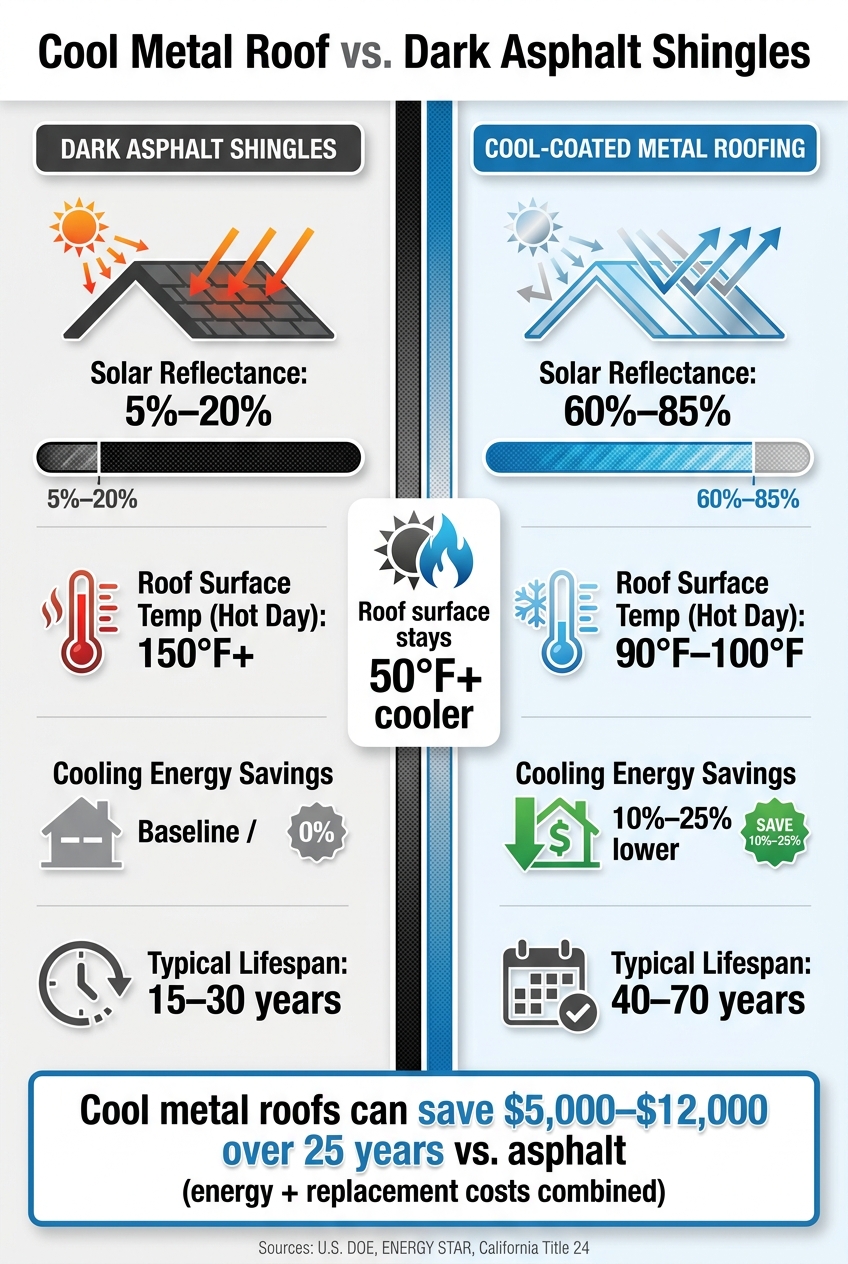
Cool Metal Roof vs. Dark Asphalt Shingles: Energy & Cost Comparison
Dark asphalt soaks up most of the sun’s heat. Cool-coated metal does the opposite: it reflects much more sunlight, stays cooler, and can cut air-conditioning use.
The numbers make that pretty clear. Dark asphalt shingles usually reflect just 5% to 20% of sunlight. Cool-coated metal roofing can reflect 60% to 85% of solar radiation. That gap is the main reason these two roof types perform so differently on heat and energy costs.
And there’s one more piece to keep in mind: the roof covering matters a lot, but it doesn’t work alone. Insulation, ventilation, underlayment, and coating quality all play a part too.
| Factor | Dark Asphalt Shingles | Cool-Coated Metal Roofing |
|---|---|---|
| Solar Reflectance | 5% – 20% | 60% – 85% |
| Roof Surface Temp (Hot Day) | 150°F or higher | 90°F – 100°F |
| Est. Cooling Energy Savings | Baseline | 10% – 25% |
| Typical Lifespan | 15 – 30 years | 40 – 70 years |
System Factors That Improve Results
A cool metal roof works best when the whole roof assembly works together. Insulation, ventilation, underlayment, and coating quality all shape how much heat makes its way into the house. Start with insulation first, because it slows the heat that gets past the roof surface.
Attic Insulation
Insulation is the thermal barrier between the attic and the conditioned living space. In older homes with weak attic insulation, upgrades can make a clear difference. In retrofit projects, adding vented nail-base insulation cut peak indoor temperatures by 3 to 5°F. Once that layer is doing its job, ventilation can help move out the heat that still builds up.
Ventilation
Balanced soffit-to-ridge ventilation helps remove trapped heat before it radiates downward. That matters most on hot days, when attic heat can pile up fast. And the layer right under the metal panels matters too, especially when roof temperatures get extreme.
Underlayment
Underlayment needs to hold up under high heat without breaking down. High-temperature synthetic underlayment is the industry standard for metal roofs because it can handle the intense heat that builds under metal panels without wrinkling or degrading - something felt paper can't count on in the same way. It also adds a second layer of moisture protection.
Roof Color and Coating Quality
When comparing roof performance, use SRI instead of looking at color alone. Two roofs can look similar and still perform very differently. High-SRI coatings hold off UV wear and keep reflecting heat for a longer period.
Conclusion
A cool metal roof can cut cooling costs in five clear ways: it reflects sunlight, stays cooler through the day, limits heat buildup in the attic, takes pressure off your AC, and keeps doing that job for decades.
That makes the biggest difference in places with long, hot cooling seasons. Over time, those savings can stack up year after year, especially as electricity rates keep climbing.
For homeowners ready to act locally, CAP Metal Build installs metal roofing in the San Gabriel Valley - built to improve comfort and help manage summer energy use.
FAQs
Do metal roofs help in mild climates?
Yes. Metal roofs can work well in mild climates because their reflective surface and high emissivity help keep indoor temperatures steadier throughout the year.
They reflect sunlight and release absorbed heat well, which can help lower energy use across different seasons. In the San Gabriel Valley, CAP Metal Build offers metal roofing built for durable, year-round energy efficiency.
Which metal roof colors stay coolest?
Lighter roof colors usually stay cooler because they reflect more sunlight and take in less heat. White and other light shades tend to do the best here.
That said, darker roofs aren't automatically out of the running. Modern pigments and coatings can help them meet cool-roof standards too. When you're comparing options, check the Solar Reflectance Index (SRI). A higher SRI means the roof surface will stay cooler in direct sunlight.
What roof features affect energy savings?
Energy savings in metal roofing mostly come down to solar reflectance and thermal emittance. Those two factors work together to form the Solar Reflectance Index (SRI), which measures how well a roof resists heat buildup.
Reflective paint systems, such as Kynar 500, can help cut heat gain. So can proper ventilation, like an air gap between the panels and the roof deck. Put those pieces together, and a metal roof can help lower cooling costs.