5 Metal Roof Features for Hot Climates
When it comes to staying cool in hot climates, metal roofs are a game-changer. They reflect heat, release absorbed warmth quickly, and can significantly reduce cooling costs. Here are five key features that make metal roofs a smart choice:
- High Solar Reflectivity: Reflects 40–70% of sunlight (up to 90% for white-coated roofs), lowering surface temperatures by 50–60°F.
- Thermal Emittance: Releases up to 90% of absorbed heat, cooling faster than asphalt or concrete.
- Ventilated Roof Assemblies: Air gaps under panels reduce attic heat by up to 22°F and improve airflow.
- Insulation Compatibility: Works well with insulation and thermal breaks to minimize heat transfer.
- Durability: Lasts 40–70 years, resists heat damage, and maintains efficiency with protective coatings like PVDF.
Metal roofs not only cut energy bills by 10–40% but also withstand extreme temperatures and harsh conditions, making them ideal for regions like Southern California. While upfront costs range from $8–$16 per square foot, the long-term savings and lifespan make them a cost-effective investment.

Metal Roof vs. Asphalt Shingles: Performance in Hot Climates
1. High Solar Reflectivity
Think of a dark asphalt shingle as a heat sponge, soaking up solar energy, while a metal roof works more like a mirror, reflecting that heat away.
"An asphalt roof acts like a heat sink, while a metal roof acts like a mirror." - Home Pride Contractors
A light-colored or specially coated metal roof can reflect anywhere from 40% to 70% of incoming solar heat, with white metal roofs reflecting up to an impressive 90% of sunlight. In stark contrast, dark asphalt shingles only manage to reflect 5% to 15%.
When choosing a roof, pay attention to the Solar Reflectance Index (SRI). This measurement combines two factors: how well the roof reflects sunlight and how quickly it releases absorbed heat. A higher SRI means the roof stays cooler overall. If you're drawn to darker colors for aesthetic reasons, look for options with "cool pigment" technology. These specialized pigments reflect infrared light, keeping even shades like charcoal or forest green cooler.
For long-lasting performance, consider roofs with PVDF (fluoropolymer) finishes, often branded as Kynar. These coatings are known to retain their reflective properties for over 20 years without significant fading or wear.
| Roofing Material | Solar Reflectance | Potential Cooling Savings |
|---|---|---|
| Light Metal (coated) | 60–82% | 20–40% |
| Dark Metal (coated) | 25–40% | 10–25% |
| Clay Tile | 25–35% | 10–20% |
| Light Asphalt Shingles | 20–30% | 5–15% |
| Dark Asphalt Shingles | 5–15% | Minimal |
(Source: [3])
Up next, we’ll explore how thermal emittance plays a role in managing heat.
sbb-itb-e33e3b1
2. Thermal Emittance and Heat Release
While solar reflectance helps limit heat absorption, no material can reflect all solar energy. This is where thermal emittance comes into play - it measures how effectively a roofing material releases absorbed heat back into the atmosphere rather than transferring it into the building.
Metal roofing panels typically have thermal emittance ratings between 0.85 and 0.90, meaning they can release up to 90% of the heat they absorb. In comparison, materials like asphalt shingles and concrete tiles tend to hold onto heat due to their high thermal mass. This means they continue radiating warmth long after the sun sets, whereas metal roofs cool down much faster once direct sunlight is gone.
"Metal has low thermal mass, meaning it dissipates heat rapidly once the sun sets or moves behind clouds, unlike concrete or asphalt that continue radiating captured heat." - Skybird Roofing
On a hot summer day, a traditional roof can reach temperatures of 150°F or more, while a reflective metal roof can stay over 50°F cooler under the same conditions. These "cool roofs" can also lower attic temperatures by about 22°F during peak hours, reducing the strain on air conditioning systems.
"Reflectance limits how much heat gets in; emittance helps push heat back out. When both are strong, cooling performance improves significantly." - John Holum, Owner, Tristate Roofing
Interestingly, factory-painted "cool roof" finishes outperform bare or unpainted metal in terms of thermal emittance. Although bare galvanized metal might appear reflective, painted systems - especially those with PVDF (Kynar) coatings - are specifically designed to release absorbed heat more efficiently. This combination of reflectance and emittance creates a roof that not only deflects heat but also effectively sheds any heat that penetrates.
Next, we’ll take a look at how ventilated roof assemblies can further boost cooling efficiency.
3. Ventilated Roof Assemblies and Airflow
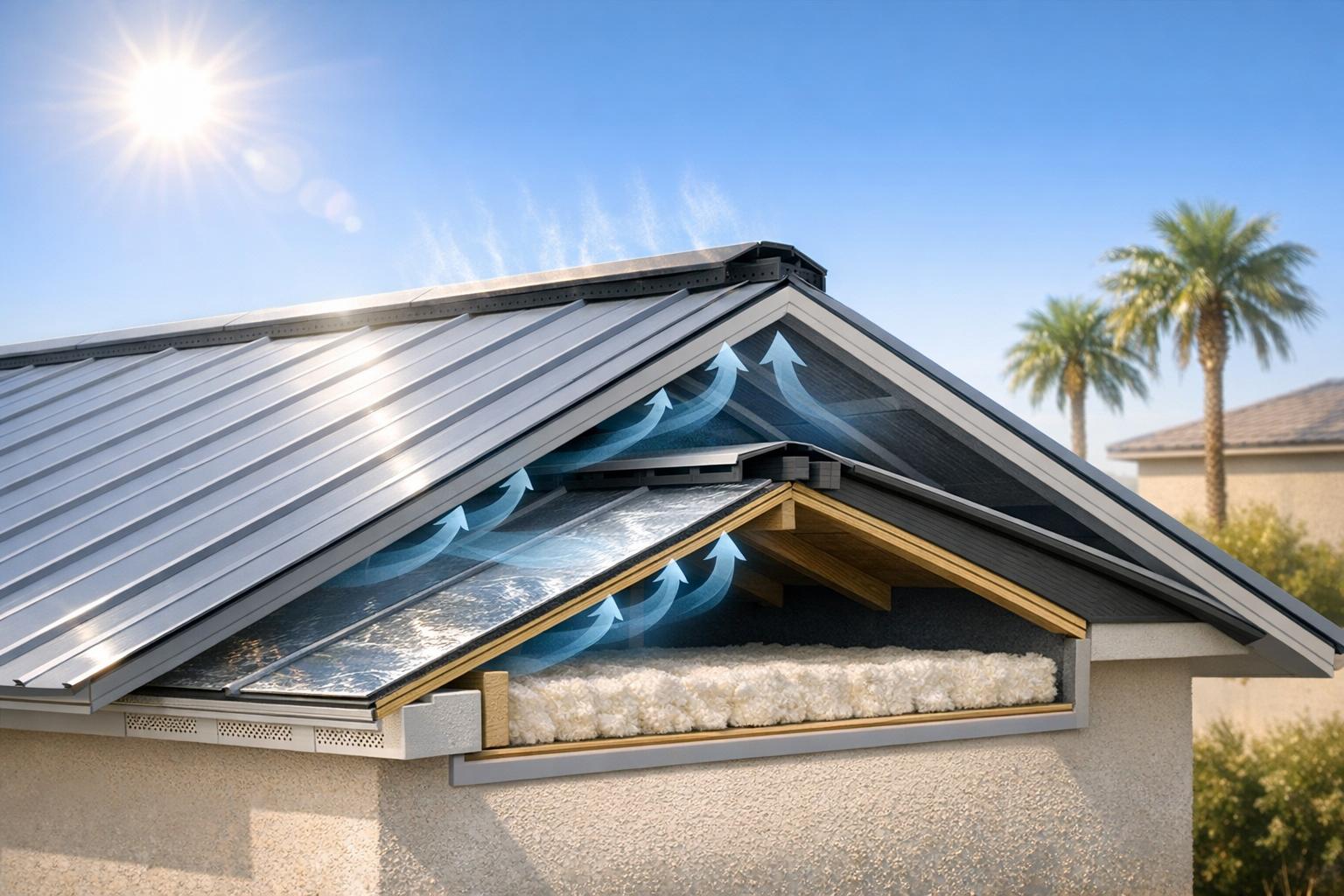
Ventilated roof assemblies play a vital role in reducing rooftop heat gain, even when using reflective metal roofs. While reflective roofs minimize heat absorption, Above Sheathing Ventilation (ASV) takes it a step further. By creating a small air gap between the metal panels and the roof deck, ASV allows convective airflow to carry away solar-heated air before it penetrates into the home.
This system adjusts naturally: as solar heat increases, airflow intensifies, enhancing the cooling effect. Tests show that buildings with ASV can achieve attic temperatures just 5°F above the surrounding air temperature, a significant improvement over conventional roof designs.
"By incorporating that air space, it always works to push the roof temperature toward ambient outdoor temperature (either naturally or forced). The rate of air flow is driven by solar gain; the higher the solar gain, the more air flows through the cavity." - Jim Bush, Vice President of Sales and Marketing, ATAS International Inc.
Studies from Oak Ridge National Laboratories reveal that a painted metal roof with a 3/4-inch ASV cavity on a 4:12 slope requires only a 0.1 solar reflectance (SR) to perform as well as a 0.25 SR direct-to-deck installation. This means even darker roofs equipped with ASV can cut cooling loads by 30%–45%.
Take the Erving Public Library in Massachusetts (2021) as an example. Its roof assembly featured ATAS International’s standing seam panels, ASV spacer shims, and a breathable vapor barrier. Paired with a photovoltaic system, this setup helped achieve an 81% reduction in energy use for the all-electric building. Beyond managing heat, the ventilated gap also allows moisture to escape, protecting both the metal panels and the roof deck from long-term damage.
This airflow enhancement works in tandem with insulation and thermal break strategies, making your roof even more energy-efficient.
4. Insulation Compatibility and Thermal Breaks
Effective heat management in metal roofs goes beyond just the material itself - it also relies heavily on insulation and thermal breaks. Metal roofs, while durable and efficient, provide minimal insulation on their own. To address this, using high-quality insulation and ensuring proper installation is crucial. Metal roofs naturally reflect solar energy, which reduces the heat load on the insulation below. For even better results, install metal panels over battens to create an air gap between the panels and the roof deck. This air gap acts as a thermal break, interrupting the direct transfer of heat from the metal surface into your home.
Thermal breaks also improve the performance of attic insulation, especially at night. Since metal has a low thermal mass, it cools quickly after sunset. This allows attic insulation to recover faster, helping maintain a comfortable indoor temperature once the sun goes down.
It's important to avoid blocking soffit vents when installing blown-in insulation. Obstructing intake ventilation can severely impact the efficiency of the entire roof system, no matter how effective the roofing material itself may be. For the best results, ensure that the roof, insulation, and ventilation are working together seamlessly. A well-integrated system like this promotes both long-term durability and energy efficiency.
5. Durability and Long-Term Efficiency
Metal roofs have an impressive lifespan of 40–70 years - outlasting traditional asphalt shingles by two to three times. This extended lifespan also translates into decades of consistent energy efficiency.
Unlike asphalt shingles, which contain petroleum-based binders that degrade under prolonged heat exposure, metal roofs are designed to withstand harsh conditions. Ariel Istueta, CEO of Metal Master Shop, highlights this durability:
"Hot climates tend to shorten the grace period for shingles compared with milder regions, while metal often remains stable longer when installed and detailed correctly."
Another key factor is the advanced coatings applied to metal panels. PVDF coatings, like Kynar 500, incorporate fluorine-carbon bonds that protect against UV damage, chalking, and color fading. These coatings often come with warranties of up to 30 years, ensuring reliable performance over the long term.
To maintain this durability, regular inspections are essential. Fasteners and sealant lines can expand and contract due to extreme heat, so keeping an eye on these areas is important. Additionally, removing dust and debris helps preserve the roof’s reflective properties.
| Feature | Metal Roofing | Asphalt Shingles |
|---|---|---|
| Typical Lifespan | 40–70 years | 15–30 years |
| Solar Reflectance | 40–70% | 5–25% |
| Heat Response | Dissipates heat rapidly | Absorbs and retains heat |
| Aging Mechanism | Finish/fastener wear | Oxidation and brittleness |
| Cooling Savings | 10–25% | 0–5% |
(Source: Metal Master Shop, Skybird Roofing)
These durability advantages set the stage for the region-specific considerations discussed in the next section.
Southern California Considerations
Southern California enjoys over 280 sunny days a year, but that abundant sunshine also drives up residential energy bills due to solar heat gain. Add to this the intense UV rays, fierce Santa Ana winds reaching speeds of over 60 mph, and the ever-present risk of wildfires, and it's clear that roofs in this region need to handle more than just the basics. They must reflect heat, endure harsh conditions, and offer solid fire protection.
Fire safety is a top priority here. High-quality metal roofs with a Class A fire rating provide excellent defense against wind-carried embers, which is especially important in wildfire-prone areas like the San Gabriel Valley. On top of that, installing fire-resistant roofing could potentially help lower your insurance premiums.
Energy efficiency is another must-have. California’s building codes are increasingly requiring cool roofs, and reflective metal panels with protective coatings are a perfect match for these regulations. In coastal areas, from Santa Barbara to San Diego, homeowners should consider aluminum or Galvalume panels with protective coatings. These materials are specifically designed to resist the corrosive effects of salty ocean air.
For homeowners in the San Gabriel Valley and the greater Los Angeles area, CAP Metal Build offers tailored metal roofing solutions that address these unique challenges. They manage permitting - including navigating city-specific requirements in places like Pasadena - and customize materials and installation to meet HOA standards and the demands of the local climate. This expertise ensures that your roof not only meets energy codes but also performs well in Southern California's tough environment.
When it comes to costs, installing a metal roof in Southern California typically ranges from $8 to $16 per square foot, with total project expenses falling between $20,000 and $60,000, depending on the materials and the complexity of the roof. While the upfront investment may seem steep, the long-term benefits are hard to ignore. Homeowners can save 10–40% annually on cooling costs, and metal roofs last 40 to 70 years, making them a durable and cost-effective choice.
Conclusion
A metal roof does more than just shield your home - it actively helps maintain cooler indoor temperatures while reducing energy use. Its features work together to create a more comfortable living environment in hot climates. High solar reflectivity deflects most of the sun's heat before it penetrates your home, and thermal emittance ensures that any absorbed heat escapes quickly instead of radiating into your living spaces after sunset.
On top of that, ventilated roof assemblies provide an extra layer of protection by promoting airflow that removes heat from the roof deck. When combined with insulation compatibility and thermal breaks, you get a system designed to minimize heat transfer at every level. These features together can lower cooling costs by 20% to 40%.
Durability is another key factor. As CAP Metal Build explains: "Most roofing systems are designed around replacement cycles, while metal roofing is designed around longevity." With a lifespan of 40 to 70 years - nearly twice that of asphalt shingles - metal roofs deliver consistent energy savings while reducing the need for frequent replacements, even in extreme heat.
Although the upfront cost is higher, the long-term benefits make metal roofing a smart choice. Over 50 years, homeowners can see significant savings from reduced energy bills, fewer replacements, and even insurance discounts of 10% to 30%. For those in hot climates, metal roofing offers not only financial returns but also a cooler, more efficient home.
FAQs
What metal roof color stays coolest in hot climates?
In warm climates, white is the best choice for a metal roof if you’re looking to keep things cool and energy-efficient. This color reflects the most sunlight, helping to reduce heat absorption. Other light shades, such as beige, tan, and light gray, also perform well in reflecting heat. Interestingly, with advancements in cool pigment technology, even darker roof colors can now reflect a surprising amount of heat. To make the best decision, pay close attention to the Solar Reflectance Index (SRI) of the product, as the finish and coating play a big role in managing heat effectively.
Do I need a ventilated roof assembly (air gap) with a metal roof?
A ventilated roof assembly, also known as Above Sheathing Ventilation (ASV), isn't mandatory in every situation, but it’s a smart choice for improving energy efficiency in hot climates. This system works by adding an air gap between the metal panels and the roof deck, allowing hot air to escape before it can transfer heat into your home. This helps lower cooling demands and keeps indoor temperatures more manageable. If you're considering whether this setup is right for your project, CAP Metal Build can assist in making the best decision for your needs.
Will a metal roof lower my A/C bills if my attic insulation is poor?
A metal roof can play a role in cutting cooling costs, but its effectiveness depends heavily on having the right attic insulation. While metal roofs are designed to reflect heat and reduce how much of it seeps into your attic, inadequate insulation can still let heat pass into your home. To get the most energy savings, CAP Metal Build advises pairing a metal roof with proper insulation and ensuring your attic has good ventilation to help expel trapped heat efficiently.