Domestic vs Imported Metal: Durability Insights
Here’s the short answer: metal lasts based on its specs, coating, and quality control - not just whether it was made in the U.S. or overseas.
If I were comparing options for a home in Southern California, I’d focus on a few things first:
- Mill certification (MTC) to confirm strength, thickness, and coating weight
- Coating type, like AZ50/AZ150 or G90
- Paint system, especially PVDF vs. SMP
- Climate exposure, such as salt air near the coast or high UV inland
- Roof design, since standing seam usually lasts longer than exposed-fastener panels
A few numbers make the point fast:
- Metal roofing can last 40 to 70 years
- AZ150 can last about 6,000 hours in salt-spray testing before first rust, versus about 1,000 hours for G90
- In coastal settings, AZ150 may last 20–25 years, while galvanized steel may last 5–7 years
- PVDF finishes often hold color for 30–40 years, while SMP may last about 12–20 years in the same conditions
- Salt air can move 2 to 4 miles inland, and up to 7 miles through open valleys
So if you’re choosing between domestic and imported metal, I’d keep the question simple: Does it meet the right standard, and can the seller prove it? That matters more than country of origin alone.
Quick Comparison
| Factor | What I’d Look For | Why It Matters |
|---|---|---|
| Origin | Domestic or imported with paperwork | Origin alone does not predict lifespan |
| Certification | MTC and ASTM compliance | Confirms what you’re buying |
| Steel strength | Grade 50 | Helps with forming, wind loads, and panel performance |
| Coating weight | AZ50/AZ150 or G90 | Heavier coating usually means better rust resistance |
| Paint finish | 70% PVDF | Better fade and chalk resistance in sun |
| Coastal use | Aluminum, 316 stainless, or PVDF systems | Salt air wears metal faster |
| Inland use | PVDF-coated Galvalume | Better for heat and UV |
Bottom line: if I wanted a roof or exterior metal product to last, I’d judge it by tested specs, coating level, finish type, and proof of compliance. That is what the research keeps pointing to.
sbb-itb-e33e3b1
Research Scope and Material Definitions
How Studies Classify Domestic and Imported Metal
Research doesn’t sort metal by where it was shipped from. It sorts metal by standards compliance and certification.
In research, domestic means the material is documented to U.S. manufacturing standards and backed by mill certification. Imported materials are typically those tested without the same documentation or with different coating specs. So origin by itself doesn’t tell you how the metal will perform.
That distinction matters because the comparison that follows is based on measurable material properties, not a label.
Which Material Properties Researchers Measure
Studies look at the same core properties across materials. Tensile strength and elongation show how well the metal handles wind loads and whether it can be formed without cracking. Base metal thickness sets the baseline for structural performance, while yield strength also plays a role in dent resistance.
Researchers also compare coating mass - such as zinc or aluminum-zinc coverage - because that affects corrosion resistance. Paint performance is measured for UV fading and chalking resistance. For corrosion, studies use salt-spray testing under ASTM B117. And dimensional consistency helps show whether panels will stay uniform enough for seam strength and weather-tightness.
| Property Measured | What It Reveals |
|---|---|
| Tensile Strength | Resistance to wind and structural loads |
| Coating Mass | Sacrificial corrosion protection (e.g., AZ50, G90) |
| Paint Performance | UV fading and chalking resistance, measured in Hunter units |
| Corrosion Resistance | Performance in salt-spray testing (ASTM B117) |
| Dimensional Consistency | Panel uniformity for proper seam strength and weather-tightness |
These are the main variables researchers use to compare strength, coating quality, and long-term durability.
Study Findings on Strength, Coating Quality, and Consistency
Strength and Formability Results
The study points to Grade 50 structural steel as the go-to standard for standing seam systems. It offers 50–65 KSI yield strength and 20%+ elongation, which gives panels enough strength while still letting them form cleanly without cracking.
By comparison, Grade 33 is weaker and is usually used for gutters. Grade 80 sits at the other end of the spectrum: it’s so brittle that it can crack during rollforming. So this isn’t just about picking the strongest steel on paper. If the metal can’t bend the way the system demands, problems show up fast.
As Jim D. Koontz, RRC, PE, noted:
"The random results of indentation, diameter, and depth in two metal roofs with the same gauge is most likely due to variation in yield strength."
That quote gets to the heart of it. Two roofs can look similar by gauge, yet perform very differently if the yield strength shifts from batch to batch. Lower-spec coils tend to show more of that variation and may not even meet Grade 50 requirements. And strength, by itself, doesn’t settle the durability question. Coating quality and manufacturing consistency play just as big a part in how long the roof lasts.
Coating Thickness and Manufacturing Consistency
For painted Galvalume, AZ50 is the standard. Lower-cost options may use AZ40 or AZ35, which increases the chance of early edge rust. On the paint side, PVDF finishes should contain at least 70% resin. Lower-spec coatings often cut that number or switch to SMP, which tends to chalk and fade sooner.
Consistency in size and thickness is another area where quality gaps show up. Some suppliers make gauge claims look better by counting the paint film instead of the substrate thickness. That sounds small, but it can affect panel strength and make oil canning more likely - the visible waviness you sometimes see after installation.
Here’s how those differences show up in service:
| Measurable Property | Specified Standard | Lower-Spec Variation | Real-World Impact |
|---|---|---|---|
| Yield Strength | 50–65 KSI (Grade 50) | Inconsistent (Grade 33 or Grade 80) | Oil canning, cracking, or hail vulnerability |
| Coating Mass | AZ50 (Galvalume) / G90 (Galvanized) | AZ40 or lower | Premature corrosion and edge rust |
| Paint Resin | 70% PVDF minimum | <70% PVDF or SMP/Polyester | Rapid fading, chalking, and film failure |
| Gauge and Batch Consistency | Mill-certified substrate gauge, tight tolerances | Paint-film-inflated gauge claims; batch-to-batch variation | Forming defects and reduced structural reliability; rollforming problems and panel distortion |
Domestic steel is usually mill-certified, which means its chemical makeup and physical properties can be checked against paperwork. Imported metal - especially material bought through secondary markets - may not come with that same paper trail, which makes verification tougher. That gap matters most when panels are exposed to salt, humidity, and UV over time.
The next issue is how those material differences hold up in salt, humidity, and industrial air.
Corrosion Resistance and Climate Effects
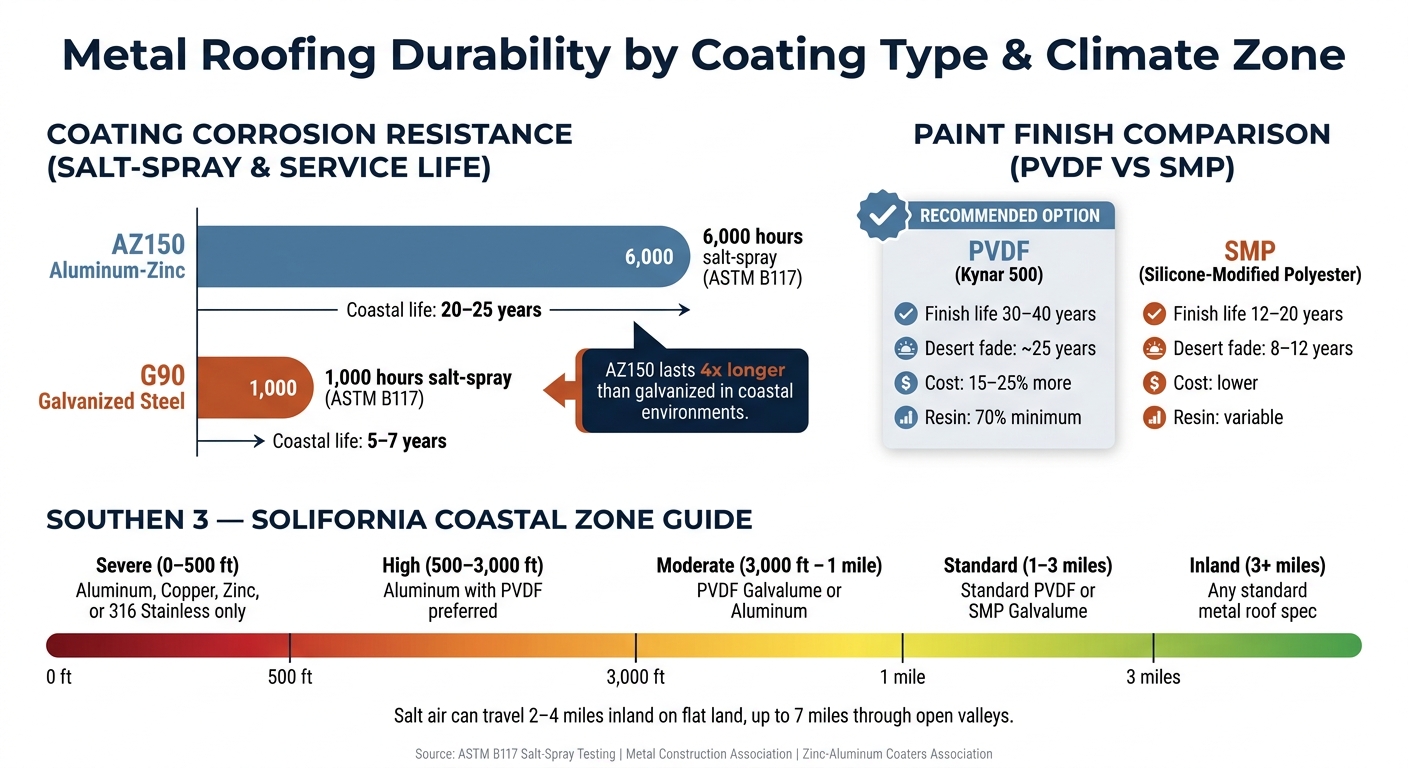
Metal Roofing Coating Comparison: AZ150 vs G90 vs PVDF vs SMP by Climate Zone
Study Results in Marine, Humid, and Industrial Environments
Research shows that rust risk depends more on coating chemistry and thickness than on where the metal was made. That’s the main thing to watch. Once chlorides start breaking down the protective layer, they can move through tiny cracks in the coating and start the corrosion process. In marine and industrial settings, where that exposure keeps happening, wear speeds up.
ASTM B117 salt-spray testing shows a sharp difference between coating types. AZ150 aluminum-zinc coated steel reaches 6,000 hours before first rust appears, while standard G90 galvanized steel reaches that point at only 1,000 hours. Out in coastal conditions, that gap shows up in service life too: 20–25 years for AZ150 versus 5–7 years for galvanized steel.
A December 2014 study by the Metal Construction Association and the Zinc-Aluminum Coaters Association looked at 10 unpainted Galvalume standing seam roofs that were 20 to 35 years old across several U.S. climates. The study found that those 10 unpainted Galvalume standing seam roofs aged 20 to 35 years still had pliable butyl sealants and no significant red rust, even at sheared edges.
Rain chemistry matters too. Cleaner rainfall increases projected Galvalume life from about 86 years to 119 years as pH rises from 4.4 to 4.8.
| Environment | Galvanized Failure | AZ150 Failure | Life Extension |
|---|---|---|---|
| Coastal | 5–7 years | 20–25 years | 4x |
| Industrial | 6–8 years | 18–22 years | 3x |
| Rural | 10–12 years | 25–30 years | 2.5x |
Paint choice also plays a big role. PVDF (Kynar 500) is the go-to option for coastal and high-UV areas, with 30–40 years of finish life. By comparison, Silicone-Modified Polyester (SMP) usually lasts 12–20 years in the same conditions.
That difference matters a lot in coastal California, where conditions can change fast within a short drive.
How Southern California Conditions Affect Service Life
These corrosion and coating limits show up clearly in Southern California. Near the coast, salt is the main problem. Farther inland, the bigger issue is UV exposure and heat-driven movement.
Salt-heavy air doesn’t stay right at the beach. Prevailing onshore winds can carry it 2 to 4 miles inland across flat land, and as far as 7 miles through open valleys. That means a home that looks “far enough” from the shoreline may still be dealing with salt exposure.
Move inland, and the failure pattern changes. Dark metal panels in inland Southern California can reach surface temperatures above 160°F, which drives strong expansion and contraction cycles. Over time, that kind of movement can be hard on finishes and fastener areas. PVDF handles those high-UV conditions better than SMP. In desert parts of Southern California, PVDF takes about 25 years to reach a noticeable fade level, while SMP gets there in about 8 to 12 years.
| Zone | Distance from Coast | Recommended Substrate |
|---|---|---|
| Severe | 0–500 ft | Aluminum, Copper, Zinc, or 316 Stainless only |
| High | 500–3,000 ft | Aluminum (PVDF preferred) |
| Moderate | 3,000 ft – 1 mile | PVDF Galvalume or Aluminum |
| Standard | 1–3 miles | Standard PVDF or SMP Galvalume |
| Inland | 3+ miles | Any standard metal roof spec |
One maintenance step stands out across coastal zones: an annual low-pressure freshwater rinse in late spring to wash off built-up chloride salts. Studies suggest that this simple step can add 10 to 20 years to the life of PVDF coatings.
Evidence-Based Takeaways for Material Selection
What Homeowners Should Prioritize When Selecting Metal
The research lands on one clear rule: standards compliance and documented coating quality matter more than where the metal comes from. Ask for the MTC first. It confirms chemistry, strength, and coating weight.
Start with verification. After that, coating and fastening details play a big role in how the roof holds up over time. PVDF (Kynar 500) performs better than SMP when it comes to UV resistance and color retention. It usually costs 15%–25% more, but it can roughly double cosmetic lifespan.
System design matters too. Hidden-clip standing seam roofs tend to outlast exposed-fastener systems. In coastal areas, aluminum or 316 stainless steel are the preferred substrates. In high-UV inland areas, PVDF-coated Galvalume is usually the better match. That matters even more in Southern California, where strong sun and salt air can speed up finish failure.
Key Points from the Research Summary
The studies point in the same direction: coating quality, quality control, and climate drive service life more than origin alone. For the San Gabriel Valley, PVDF-coated standing seam systems are the best fit because the area’s high UV exposure favors coatings with better chalk and fade resistance.
A few checks should stay on the list:
- Title 24 compliance is required.
- Class A fire ratings matter in wildfire-prone areas.
In the San Gabriel Valley, those specs line up with local conditions, especially high UV exposure and wildfire risk.
FAQs
How can I verify metal quality before buying?
Ask for independent third-party lab reports that show the product meets standards like UL, CE, or ISO 9001.
You should also ask for paperwork that shows:
- Tensile strength
- Aluminum-zinc coating thickness, with at least 20 microns for corrosion resistance
Then confirm the product was tested for:
- Wind uplift
- Impact resistance (UL 2218)
- Fire resistance
And one more thing: get the product warranty and the installation workmanship warranty in writing. A verbal promise is easy to make. A written warranty is what counts if something goes wrong.
Which coating is best for coastal homes?
For coastal homes, PVDF is the coating most pros point to. It's often sold under brand names like Kynar 500 or Hylar 5000, and it stands up well to salt spray, UV rays, and chalking.
If your home is near the coast or gets marine air, this higher-end system is a better pick than standard polyester or SMP finishes. CAP Metal Build recommends a two-coat PVDF system for long-term protection and appearance.
Is PVDF worth the extra cost?
It comes down to your long-term goals.
PVDF is a premium coating. It gives you better color stability, stronger resistance to chalking, and more UV protection than lower-cost options like SMP.
If you want a clean, even look and color that stays bright for 30 years or more, PVDF is often the smarter buy. In high-UV areas like the San Gabriel Valley, it may also help cut attic heat and lower cooling costs.