How to Prevent Rust on Coastal Metal Roofs
Salt can start damaging a metal roof long before you see red rust. If I want a coastal metal roof to last, I need to do four things from the start: pick the right metal, use the right finish and fasteners, keep water moving off the roof, and wash salt off on a set schedule.
Here’s the short version:
-
Use the right metal for the location.
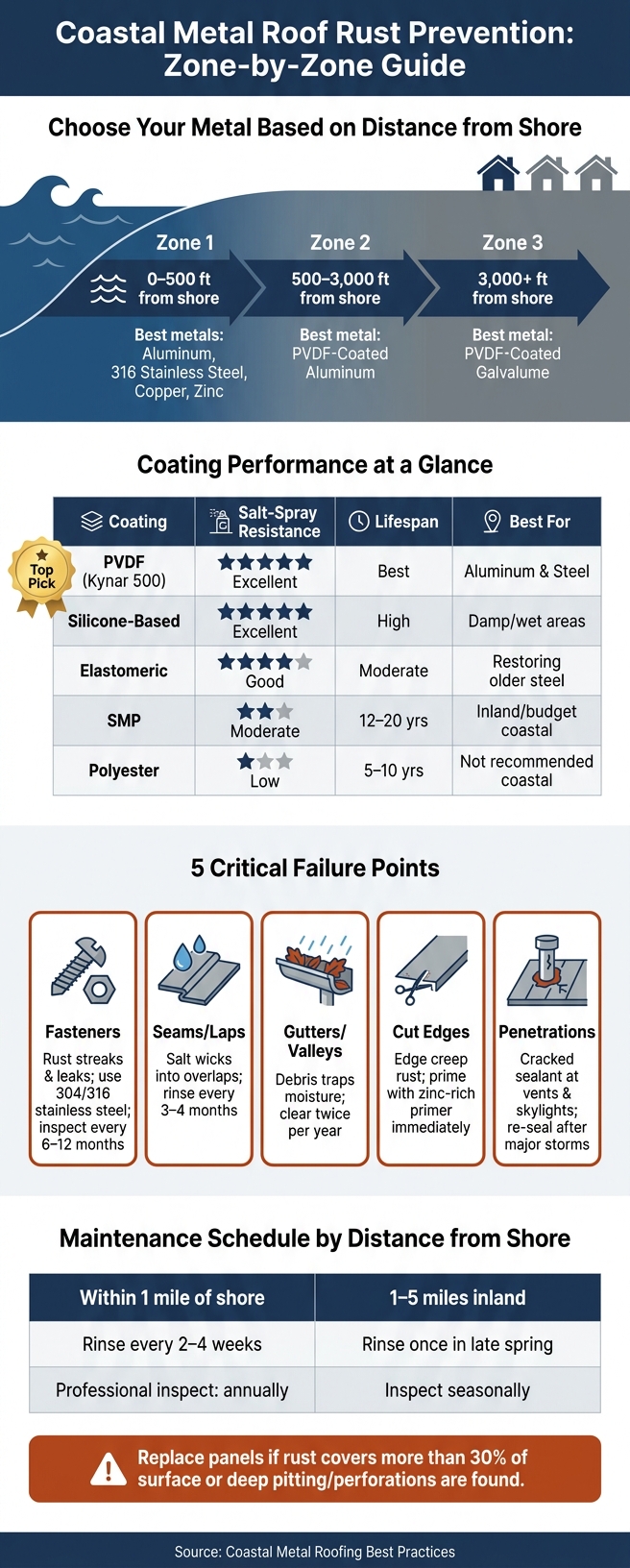
Within 500 feet of the shore, I’d stick with aluminum, 316 stainless steel, copper, or zinc. From 500 to 3,000 feet, PVDF-coated aluminum is usually the safer pick. Beyond 3,000 feet, PVDF-coated Galvalume can work. -
Don’t let small parts ruin the roof.
A lot of rust starts at fasteners, flashings, seams, and cut edges. I’d use 304 or 316 stainless steel screws, match metals where I can, and isolate dissimilar metals with dielectric separators or neoprene gaskets. -
Use a coating system made for salt and sun.
PVDF holds up best in coastal conditions. If I’m fixing light rust, I’d clean the area first, use the right primer, and never coat over active rust. -
Keep drainage clear.
Salt and moisture sit in valleys, laps, gutters, and around penetrations. That’s where corrosion often starts first. -
Rinse the roof on a schedule.
If the home is within 1 mile of the shore, I’d rinse with water every 2 to 4 weeks. Farther inland, at least once a year in late spring still matters because salt can travel inland on wind and marine layer moisture. -
Know when repair is no longer enough.
If there’s deep pitting, perforation, leaks, or rust on more than 30% of the panels, I’d stop thinking about touch-up work and call a metal roofing pro.
Coastal Metal Roof: Best Materials & Maintenance by Distance from Shore
Quick Comparison
| Area | What I’d Do | Main Risk If Ignored |
|---|---|---|
| Panel material | Choose metal based on distance from shore | Early corrosion |
| Finish | Use PVDF where possible | Fading, coating failure, faster rusting |
| Fasteners | Use 304/316 stainless steel | Rust streaks, leaks, failed connections |
| Cut edges | Prime and seal all field cuts | Edge creep rust |
| Drainage | Keep valleys and gutters clear | Standing moisture and salt buildup |
| Maintenance | Rinse and inspect on schedule | Chloride buildup and hidden corrosion |
Bottom line: I wouldn’t treat coastal rust as a paint problem alone. It’s a full-roof system issue. If the metal, coating, fasteners, drainage, and maintenance plan all line up, the roof has a much better shot at staying rust-free for years.
sbb-itb-e33e3b1
Choose the Right Metal Roofing Materials and Components
Once salt exposure is clear, the next call is the roof system itself.
Best Panel Materials for Coastal and Near-Coastal Homes
Material choice has the biggest effect on how long a coastal roof lasts.
In high-salt areas, aluminum is the go-to pick because it doesn’t rust and forms a protective oxide layer. Within 500 feet of the shore, stick with 316 stainless steel, copper, or zinc. Galvalume can work farther inland, but there’s a catch: cut edges expose bare steel, so those areas need protection.
By zone, the rule is pretty simple:
- Within 500 feet: non-ferrous metals only
- 500 feet to 3,000 feet: PVDF-coated aluminum is preferred
- Beyond 3,000 feet: PVDF-coated Galvalume is acceptable
Even top-tier coastal metal still needs a finish that can stand up to salt and UV.
Factory Finishes That Resist Salt and UV Exposure
For coastal conditions, PVDF (polyvinylidene fluoride) is the top coating choice. It holds up against UV and salt spray better than SMP or polyester finishes.
It also pays to check the specs. Look for ASTM B117 testing and AAMA 2605 compliance. On the coast, SMP coatings usually last 12 to 20 years, while standard polyester finishes often fail in just 5 to 10 years.
Fasteners, Flashings, and Metal Compatibility
A lot of roof rust starts at the screws. That’s why coastal installs should use 304 or 316 stainless fasteners. Near the shore, 300-series stainless fasteners are the standard pick.
Flashings follow the same rule. Don’t pair copper flashing with aluminum or galvanized panels. Copper runoff can corrode the less corrosion-resistant metal below. Flashings, drip edges, and gutters should match the panel metal whenever possible.
If different metals have to meet, use dielectric separators or neoprene gaskets. They break the electrical contact and help stop galvanic corrosion before it starts.
Once the roof uses coastal-grade metals and matched parts, the next step is protecting the surface with the right coating.
Apply Protective Coatings and Treat Early Rust Correctly
Clean the Roof Surface Before Coating or Repair
After you pick coastal-grade metal and fasteners, the next part is simple: surface prep makes or breaks the coating.
Start by removing loose debris with a leaf blower or a soft-bristle broom. Then wash the roof with a mild, pH-neutral detergent. If you see chalky salt buildup, use a 50/50 vinegar-water rinse to cut through it.
Using a pressure washer? Keep it between 1,200 and 1,500 PSI. Let the cleaner sit for 10–20 minutes, then rinse from the ridge down to the eaves. Try to clean the roof when the surface is below 85°F. And clear the gutters and downspouts right away so salt-heavy runoff doesn't sit near the roof edges.
Treat Light Surface Rust Before It Spreads
Handle rust before you coat the roof. If you coat over active rust, you trap corrosion underneath, and that problem keeps moving.
For light surface rust, remove loose material with a wire brush or fine-grit sandpaper. Save a grinder for stubborn spots. If you notice scratches or chips, touch them up right away with manufacturer-matched paint. Once the area is clean and dry, apply a rust-converting primer, then add a coastal-rated topcoat that matches your panel type.
If you find perforations, deep pitting, or rust covering more than 30% of the panels, spot repair is no longer enough. Those panels should be replaced .
Use the Right Coating System for Coastal Conditions
Pick the primer based on the roof's condition, then choose the topcoat based on how much coastal exposure the roof gets and whether you're doing a repair or a full restoration.
Once the roof is clean, the amount of visible rust usually tells you which primer fits the job.
Primer comparison by use case:
| Primer Type | Best For | Key Benefit |
|---|---|---|
| Zinc-Rich | New metal, cut edges, fresh installs | Sacrificial cathodic protection against rust |
| Rust-Converting | Pre-rusted areas (light surface rust) | Chemically neutralizes active iron oxide |
| Epoxy | Severe marine zones | High moisture and chemical barrier |
PVDF (Kynar 500) is still the top choice for coastal resistance and is usually factory- or professional-applied . For field-applied repairs and recoating, elastomeric and silicone-based coatings are practical options .
Topcoat comparison for coastal conditions:
| Coating Type | Salt-Spray Resistance | Application | Best For |
|---|---|---|---|
| PVDF (Kynar 500) | Excellent | Factory/Professional | Aluminum & steel |
| Silicone-Based | Excellent | Moderate | Areas that stay damp |
| Elastomeric | Good | Moderate | Restoring older steel roofs |
| SMP | Moderate | Low | Inland or budget coastal applications |
Apply coatings when the surface temperature is between 55°F and 90°F and at least 10°F above the dew point. If the roof pitch is steeper than 6:12 or the building is more than two stories high, bring in a professional.
After coating, make sure water keeps moving off edges, laps, and penetrations so salt doesn't settle.
Control Drainage, Cut Edges, and Ongoing Maintenance
Prevent Moisture Traps at Places Where Water Collects: Valleys, Laps, Gutters, and Penetrations
Once the surface is protected, the main trouble shifts to the spots where water sits or salt piles up. After coating, keep water moving off the roof so salt doesn’t settle into seams and low areas. That means keeping positive drainage and avoiding low-slope sections that hold standing water.
Valleys and gutters are common weak points. Wet leaves and pine needles can hold salty moisture right against the metal. Clear valleys and gutters before the wet season and again after storms. It also helps to trim branches so there’s at least 6 feet of clearance from the roof.
Penetrations - ridge caps, vents, skylights, and flashings - often fail before the main panels. They take the brunt of salt spray and heavier runoff. For seams and penetrations, skip generic silicone caulk. Use a polyurethane or butyl sealant approved for metal roofing.
Seal and Protect Cut Edges, Fasteners, and Field Cuts and Repairs
After drainage is handled, protect every new cut, seam, and fastener so bare metal isn’t left exposed.
Cut edges are often where rust starts on a repaired or modified roof. When a panel is trimmed in the field, the cut exposes raw metal. If you leave it untreated, that edge can rust first and spread under the coating. That’s known as edge creep.
Any time you make a field cut or repair, do this before moving on:
- Clean and prep: Remove loose rust and debris, clean with a metal-safe degreaser, and let the area dry all the way before priming.
- Prime: Coat cut edges and bare spots with a zinc-rich primer rated for metal roofing.
- Seal: Use manufacturer-approved PVDF touch-up paint on scratches, or a high-grade polyurethane sealant on seams and fastener heads.
Fasteners need the same level of care. Travis Lord, Product Manager at The Garland Company, notes:
"A less extreme scenario from oxidized fasteners could be simply that the roof leaks because the fasteners rust so much that they create voids in the connection, losing their watertight seal."
For aluminum panels, pre-drill pilot holes and seal the hole edges before fastening. That helps cut down on galvanic corrosion where dissimilar metals meet.
Set a Coastal Cleaning and Inspection Schedule
Once repairs are sealed, stick to a set rinse-and-check routine so salt buildup doesn’t creep back in.
For most coastal homes, rinse the roof with fresh water at least once a year in late spring to wash off salt from the marine layer. If your home is within 1 mile of the shoreline, rinse every 2 to 4 weeks. Use a garden hose at moderate pressure, avoid pressure washing, and inspect after major storms or long wet spells.
The table below shows the roof details most likely to fail first, along with what to watch for and what to do:
| Roof Detail | Failure Risk | Preventive Action | Inspection Frequency |
|---|---|---|---|
| Fasteners | Rust streaks, washer failure, backing out | Inspect for red streaks; replace failing ones with 316 stainless steel | Every 6–12 months |
| Overlaps/Laps | Salt wicking into seams | Freshwater rinse; check sealant integrity | Every 3–4 months |
| Gutters/Valleys | Debris trapping salt and moisture | Clear leaves and needles; flush with water | Twice per year |
| Penetrations | Cracked sealant, flashing leaks | Re-seal with butyl or polyurethane at vents, chimneys, and skylights | After major storms |
| Cut Edges | Edge creep rust migrating under coating | Apply zinc-rich primer and PVDF touch-up paint | Every 6 months |
If your home is within 3,000 feet of the shoreline, schedule a professional rinse-and-inspect service at least once a year. That gives you a better shot at spotting early rust before it reaches the panel body.
Build a Long-Term Rust Prevention Plan
Once the roof is installed and coated, maintenance is what keeps salt from piling back up on the surface.
Seasonal Checklist for Los Angeles Homeowners
A steady yearly routine often protects a coastal metal roof better than any one product or repair. The timing changes a bit based on how close you are to the ocean.
| Season | Task | Within 1 mile of the shore | 1–5 miles inland |
|---|---|---|---|
| Spring | Freshwater rinse | Every 2–4 weeks | Once in late spring |
| Summer | Inspect for chalking, fading, or exposed metal | Seasonal visual check | Seasonal visual check |
| Late Summer/Early Fall | Clear leaf debris from valleys and gutters | Quarterly or after storms | Twice per year |
| Winter | Drainage check | After every major storm | After significant storms |
After Santa Ana winds, rinse the roof to wash off windblown salt that can travel 5 to 7 miles inland through open valleys.
When to Call a Metal Roofing Professional
If an inspection shows active corrosion, it’s time to shift from upkeep to repair.
Most routine work - rinsing, clearing debris, and touching up chips within 30 days - is usually something a homeowner can handle. Some issues, though, need a roofer right away.
Call a metal roofing contractor if you spot:
- Red rust streaks running down from fasteners
- Active leaks around penetrations
- Peeling or exposed metal
- Loose or rust-swollen fasteners
If rust has reached the panel metal, or if more than 30% of panels show substrate involvement, repair alone usually won’t be enough.
Conclusion: Key Steps to Keep Coastal Metal Roofs Rust-Free
That routine is the last line of defense against coastal rust.
Keeping a coastal metal roof rust-free comes down to a few early choices and steady habits. Start with corrosion-resistant materials like aluminum or PVDF-coated Galvalume, along with compatible 300-series stainless steel fasteners. Protect every cut edge and field change with manufacturer-approved touch-up paint and proper edge sealing. Keep drainage paths clear so salt doesn’t sit at seams, valleys, and penetrations. Rinse with fresh water on a schedule that fits your distance from the shore. And treat early rust within 30 days.
FAQs
How do I know if my roof is too close to the ocean for Galvalume?
It depends on how close you are to the coast and what the land around you looks like. In most cases, steel substrates are not recommended within 500 feet of the ocean because salt spray is heavy in that zone.
From 500 feet to 1 mile, Galvalume can work if you use a high-quality PVDF coating, stainless fasteners, and good edge protection. Beyond 1 mile, standard Galvalume usually performs well.
One thing to watch: west-facing hills or valleys can push salt spray farther inland than you'd expect.
Can I rinse a coastal metal roof myself without damaging the finish?
Yes. Rinsing your coastal metal roof yourself is a good way to wash off salt buildup and help prevent corrosion.
Use a garden hose with moderate water pressure. Do not use a pressure washer, because high pressure can push water and salt into panel seams or tiny cracks and harm the finish.
When does rust mean a panel should be replaced rather than repaired?
Replacement is usually the right move when rust goes past the surface and gets into the metal itself. At that point, you may see holes, deep pitting, or parts of the roof that have lost strength. By contrast, light surface rust can often be cleaned up, treated, and primed instead.
It also makes sense to plan for replacement when rust affects 30% or more of the panels, when the roof shows broad wear, or when perforations extend into the attic space.