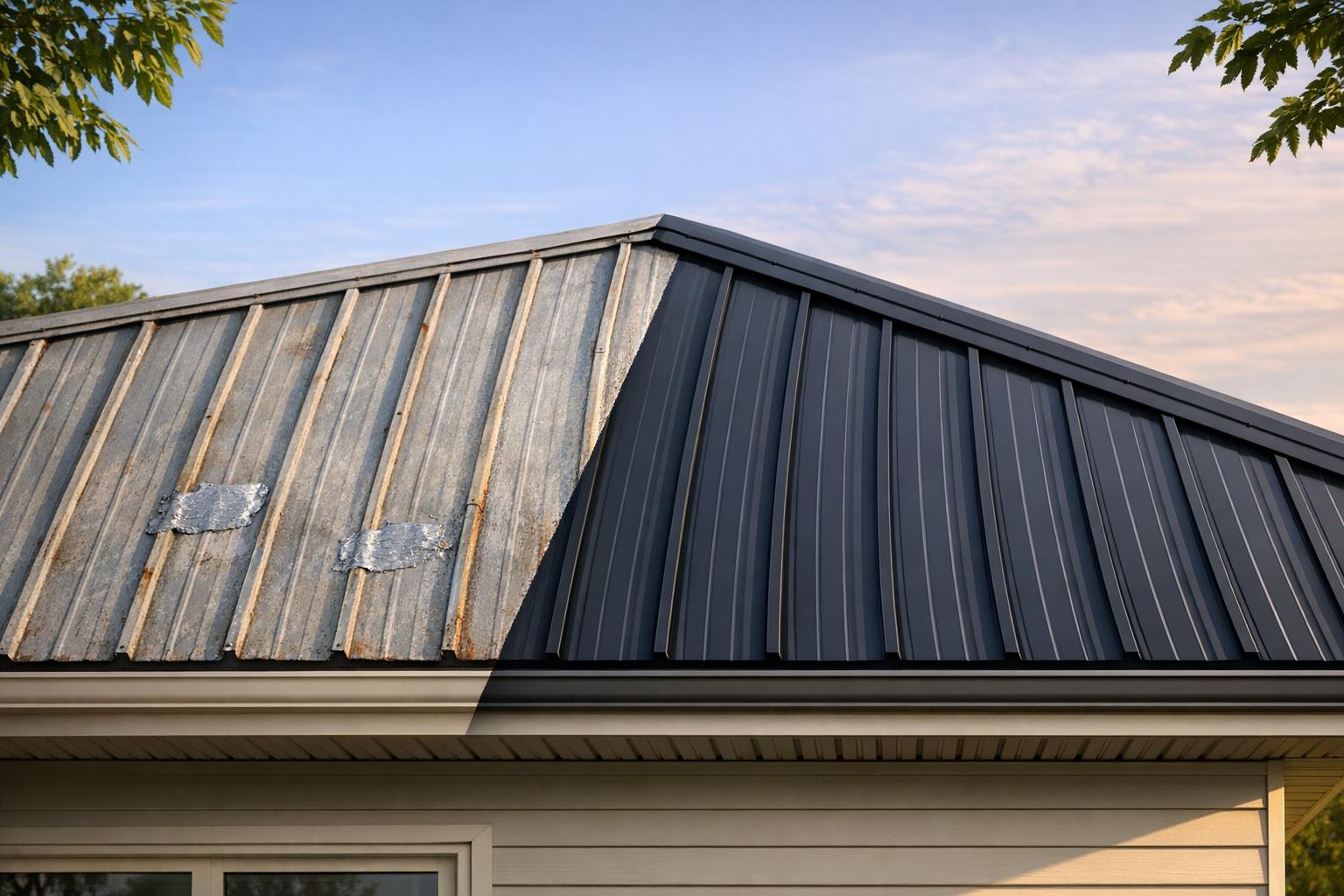
Metal Roof Repair vs Replacement: Age Factors
When deciding between repairing or replacing a metal roof, age is a key factor. Metal roofs can last 40–70 years, but their condition and remaining lifespan heavily influence the choice. Here's a quick breakdown:
- Under 15 years: Repairs are usually sufficient for minor issues like leaks or loose fasteners. Costs range from $150–$400 for small fixes.
- 15–30 years: Repairs like rust treatment or applying roof coatings can extend life, but if repair costs approach 30% of replacement costs, replacement may be smarter.
- 30+ years: Replacement is often more cost-effective, especially if damage exceeds 25% of the surface, or repair costs are high.
Key considerations:
- Material lifespan varies: Aluminum lasts 40–60 years, while copper/zinc can exceed 80–100 years.
- Environmental factors, like heat and salt exposure, impact durability.
- Insurance coverage often shifts from replacement cost value (RCV) to actual cash value (ACV) for roofs over 15–20 years, reducing payouts for repairs.
Quick Comparison
| Roof Age | Repair or Replace? | Key Considerations |
|---|---|---|
| Under 15 years | Repair minor damage | Fix leaks, replace fasteners, maintain structure |
| 15–30 years | Evaluate repair vs replacement | Rust treatment, roof coatings, insurance changes |
| 30+ years | Replacement recommended | Widespread damage, high repair costs, aging roof |
For a tailored solution, consult a professional to assess your roof's condition, warranty, and future needs.

Metal Roof Repair vs Replacement: Age-Based Decision Guide
sbb-itb-e33e3b1
Metal Roof Lifespans and Age Benchmarks
Understanding how long different types of metal roofs last is essential for deciding whether to repair or replace your roof.
How Long Different Metal Roofs Last
The lifespan of a metal roof largely depends on the material used. Here's a quick breakdown:
| Material | Expected Lifespan | Best For |
|---|---|---|
| Galvanized Steel | 25–30 years | Affordable options, though it needs more upkeep. |
| Aluminum | 40–60 years | Ideal for coastal or humid environments. |
| Galvalume Steel | 40–60+ years | Great for residential use with corrosion resistance. |
| Standing Seam | 50–70+ years | Perfect for modern designs; concealed fasteners reduce leaks. |
| Tin | 50–75 years | Suited for traditional or historic buildings. |
| Copper / Zinc | 80–100+ years | Best for luxury or historic homes due to their longevity. |
"Copper and zinc metal roofs have the best longevity at about 100 years on average." - Audrey Bruno, Contributing Writer, Angi
Steel and aluminum roofs generally last 40–60 years in the U.S., but protective coatings can extend their lifespan by an additional 10–20 years.
What Affects a Metal Roof's Lifespan
While material choice is important, other factors also play a role. For example, in Southern California, intense sunlight and heat create unique challenges. Los Angeles, with around 284 sunny days annually, sees roof surface temperatures soar to as high as 160°F during summer. This constant heating and cooling cycle causes metal panels to expand and contract, which can strain seals and fasteners over time.
Reflective coatings like Kynar 500 or PVDF finishes help counter these effects by reducing thermal stress, slowing down fading, and preventing oxidation in high-UV areas. In coastal regions, salt-laden air accelerates corrosion, making aluminum or coated steel better choices than bare galvanized steel.
"By minimizing the expansion and contraction cycles caused by temperature changes, the materials stay more stable and last longer." - Home Genius Exteriors
Beyond environmental factors, installation quality and maintenance are crucial. A properly installed roof that undergoes annual inspections - checking for loose fasteners, worn sealants, or debris in gutters - will last significantly longer than one that's neglected.
Determining Your Roof's Age and Warranty Status
To figure out your roof's age, check home records like inspection reports or permits. Paint warranties typically cover up to 30 years, while workmanship warranties can range from 2 to 25 years.
Warranty status can also influence whether you repair or replace your roof. Active warranties may cover repair costs, but once they expire, replacement might be more economical as repair bills add up. Additionally, some insurance companies downgrade coverage for older roofs from replacement cost value (RCV) to actual cash value (ACV), which lowers payout amounts for claims.
Knowing your roof's lifespan and warranty details makes it easier to decide whether to repair or replace it.
When Repairing a Metal Roof Makes Sense
Not every roofing issue requires a complete replacement. In fact, in many situations, a targeted repair can be the smarter and more cost-effective solution. The decision to repair often depends on the roof's age and condition - early-life roofs typically need minor fixes, while midlife roofs may require more extensive care. For older roofs, repairs often serve as temporary measures while planning for replacement.
Repairs for Early-Life Roofs (Under 15 Years)
A metal roof less than 15 years old is usually in excellent shape structurally. If you notice a leak or minor damage during this stage, repairing it is almost always the best option. The problems are typically isolated, and the underlying structure remains solid.
One of the most common issues - accounting for about 60% of leaks - is loose or failed fasteners. Fixing this is straightforward: replace the screws with ones that are ¼" longer or slightly larger in diameter, and use a new EPDM washer to ensure a watertight seal. These minor repairs generally cost between $150 and $400.
"Metal roofing screws have rubber EPDM washers that create a watertight seal. Over time, these washers degrade from UV exposure and temperature cycling." - R&E Roofing
Other early-life repairs include sealing small punctures caused by storm debris and fixing flashing around vents or chimneys. These quick fixes can help preserve the life of a roof that still has many years left.
As a roof ages, the type of damage shifts from isolated issues to more widespread material wear, requiring different repair approaches.
Repairs for Midlife Roofs (15–30 Years)
Between 15 and 30 years, signs of wear like fading coatings, minor rust, and seam separation become more noticeable. However, these problems can still be addressed if the damage is limited to less than 20% of the roof surface.
For rust spots, wire-brush the affected areas to expose bare metal, apply a rust-inhibiting primer, and seal seams with butyl tape or polyurethane sealant. These steps can effectively address localized issues.
One of the most impactful midlife repairs is applying a professional roof coating system. Elastomeric or silicone coatings can add 15 to 25 years to a roof's lifespan. While these coatings cost around $3–$7 per square foot installed, they are still far less expensive than a full roof replacement.
Repairs for Late-Life Roofs (30+ Years)
When a roof reaches 30 years or more, repairs often serve as temporary fixes while planning for a replacement. At this stage, issues like widespread rust, brittle sealants, and recurring leaks are common, signaling that the roof is nearing the end of its useful life.
In these cases, patching localized holes or minor leaks can buy some time, but if repair costs exceed 30% of a new roof's price, replacement becomes the more economical choice.
"A roof replacement is typically the better choice if repair costs exceed 30% of the price of a new one or if the roof is nearing the end of its expected lifespan." - Mandy Sleight, Insurance Expert, Kin
Additionally, as a roof ages beyond 15–20 years, many insurance companies may reduce claim payouts by switching to Actual Cash Value (ACV) coverage. This shift can reduce the financial benefits of continued repairs, making timely replacement planning even more critical.
When Metal Roof Replacement Is the Better Choice
Once you've considered repair options, it's important to recognize when replacement becomes the smarter investment. As a roof ages and repair needs pile up, replacing it ensures long-term durability. At some point, continuing to patch up an old roof stops being cost-effective - identifying that tipping point can save you from throwing money at a structure that's beyond saving.
Signs That Point to Replacement
Some damage simply can't be fixed. Extensive corrosion is a major red flag. When rust spreads across large portions of the roof, it weakens the metal to a degree that spot repairs can’t address. Similarly, warped or buckled panels create gaps that allow moisture to seep in, loosening fasteners and leaving the roof vulnerable to further damage.
"If more than a quarter of your roof shows damage, it might be smarter to replace it entirely rather than patching it up." - Joseph Elshazly, President and CMO, Rapid Restoration Group
A sagging or drooping roofline is another clear indicator that replacement is necessary. This often signals severe moisture damage to the underlying structure, which surface repairs cannot resolve. Other warning signs include seeing daylight through attic boards or noticing multiple water stains on interior ceilings. These issues suggest the roof has deteriorated to the point where repairs are no longer a practical solution.
Beyond visible damage, financial factors also play a key role in determining whether replacement is the better choice.
How Repair Costs and Warranty Status Factor In
When repair costs start approaching 30% of the price of a full replacement, it's time to consider replacing the roof. On average, replacing a metal roof costs between $11,700 and $28,700, depending on factors like material type, roof size, pitch, and location. Comparing repair estimates against this range often clarifies the decision.
Warranty and insurance coverage also influence the equation. Many insurers shift coverage for roofs older than 15 to 20 years from Replacement Cost Value (RCV) to Actual Cash Value (ACV). Under ACV, payouts are reduced based on depreciation, leaving older roofs with less financial protection. If your roof's warranty has expired and your insurance coverage has shifted to ACV, replacement may make more financial sense.
Beyond cost considerations, replacing an aging roof can bring several long-term advantages.
Benefits of Replacing an Aging Metal Roof
A new metal roof does more than fix immediate problems - it gives your home a fresh start. Modern roofing materials often come with advanced reflective coatings that can reduce energy bills, something older materials lack. Additionally, installing a new roof may qualify you for insurance discounts, potentially saving you over $980 per year.
Replacement also ensures compatibility with new systems. For example, if you're planning to install solar panels or upgrade your gutters, replacing an old roof first is a practical step. Installing solar panels on a roof that might fail soon could lead to costly removal and reinstallation later. A new roof provides a clean slate, offering 40 to 70 years of reliable protection instead of gambling on the remaining life of a deteriorating structure.
A Practical Framework for Age-Based Repair or Replacement Decisions
This framework combines your roof's age with financial considerations and future plans to help you decide between repair or replacement. Start by understanding your roof's age, then weigh your budget and long-term goals.
Repair or Replace? Recommendations by Roof Age
You can think of your roof's lifespan in three stages:
- Roofs under 15 years old: Repairs are often the most practical option for isolated damage. At this stage, fixing specific issues is usually far cheaper than replacing the entire roof.
- Midlife roofs (15–30 years): These require a more detailed evaluation. Many insurance companies transition coverage from Replacement Cost Value (RCV) to Actual Cash Value (ACV) during this period, which can reduce claim payouts. If repair costs approach 30% of the replacement cost, replacement might be the smarter financial move. In regions like Southern California's San Gabriel Valley, where intense heat can degrade roofing materials, an aging roof may also increase energy costs due to reduced reflectivity.
- Roofs over 30 years old: If more than 25% of the roof surface is damaged, replacement is usually the better choice. Repairs at this stage often address surface-level issues but fail to resolve deeper structural problems.
| Roof Age | General Guidance | Key Threshold |
|---|---|---|
| Under 15 years | Repair isolated damage | Repairs within cost benchmarks |
| 15–30 years | Assess repair vs. replace | Insurance shifts from RCV to ACV |
| 30+ years | Favor replacement | Damage exceeds 25% of the surface |
How Long-Term Plans and Budget Affect the Decision
Your future plans for the home play a big role in this decision. If you're planning to stay for 20 years or more, a full replacement often makes sense. The upfront cost can be offset by better protection and energy savings over time. On the other hand, if you're preparing to sell soon, a repair might suffice to maintain the home's marketability without the expense of a new roof.
For those unable to replace the roof immediately, targeted repairs can be a temporary solution. However, keep an eye on repair costs - if they start nearing the price of a full replacement, it’s time to rethink your approach.
How CAP Metal Build Helps Homeowners Decide

Making the right call often requires expert input. CAP Metal Build provides detailed, age-based inspections that go beyond surface-level evaluations. Their team assesses factors like panel condition, fasteners, sealants, and signs of moisture damage to give you a clear understanding of your roof's health.
Instead of pushing a one-size-fits-all solution, CAP Metal Build tailors their recommendations based on your roof's age, current condition, and your long-term plans. Whether you need a precise repair, a phased strategy, or a complete replacement, they offer honest advice. If you decide on a replacement, they can also help you plan additional upgrades, like solar panels or new gutters, to maximize your investment.
Conclusion: Repair, Replace, or Take a Closer Look?
The age of your roof plays a huge role in deciding between repairs and a full replacement. If your roof is under 15 years old and the damage is minor, repairs are often the way to go. However, if your roof is older and showing widespread issues, replacing it might save you money and headaches in the long run. For roofs between 15 and 30 years old, the choice can get trickier and requires a thorough evaluation.
A good rule of thumb is the "30% rule": if repair costs exceed 30% of what a new roof would cost, replacement is usually the smarter option. But don’t stop there - think about your insurance coverage and long-term plans for the property. These factors, combined with the financial benchmark, can guide you toward a well-informed decision.
Insurance expert Mandy Sleight emphasizes the importance of professional input:
"A roof inspector will assess the condition of your roof and look for signs of damage. The inspector can also give you an estimate of how long your roof is likely to last before it needs to be replaced."
For homeowners in the San Gabriel Valley, CAP Metal Build offers inspections tailored to your roof’s age and condition. With a clear understanding of your roof’s current state, you’ll feel confident in choosing the best path forward.
FAQs
How can I tell how old my metal roof is?
To figure out how old your metal roof is, start by reviewing your purchase or installation records. If those aren't available, look for visible signs of aging, like wear, rust, or other forms of deterioration. For a more accurate evaluation, you might want to reach out to a professional who can offer an expert opinion. Since metal roofs generally last anywhere from 40 to 70 years, assessing its current condition is key to deciding whether repairs or a full replacement are needed.
How do I estimate repair costs vs replacement costs for the 30% rule?
To figure out whether to repair or replace a roof using the 30% rule, compare the cost of repairs to the total replacement value of the roof. If the repair costs are 30% or more of what it would take to replace the roof, it might make more sense financially to go for a full replacement.
For instance, the average cost of repairing a metal roof is about $1,913, while replacing it could be significantly pricier. When making this decision, also factor in the roof’s age, the extent of the damage, and its overall condition to ensure you're choosing the most cost-effective option.
Will my insurance pay less if my metal roof is over 15–20 years old?
Insurance companies may reduce payouts for metal roofs that are over 15–20 years old. Older roofs are often viewed as more susceptible to damage, which can lead to lower coverage amounts and potentially higher premiums, as insurers tend to classify them as higher-risk.